- AI Toast
- Posts
- ChatGPT Accused of Being 'Suicide Coach'
ChatGPT Accused of Being 'Suicide Coach'
Plus: How to Automate Tasks with Runable

Poonam Soni
November 11, 2025

In partnership with

Welcome to AI Toast!
Here’s what’s on the menu today:
Parents sue OpenAI after son’s suicide
Lovable: 8 Million Users
Google Research introduces Nested Learning
Superhero Tools (Prototyping)
Automate Tasks with Runable
Quick AI Toasts: Wikipedia’s being a crybaby.
Total read time: About 5 minutes, perfect for an Americano.

A California family is suing OpenAI after their teenage son took his life, alleging harmful chatbot responses. This heartbreaking case ignites fresh debate over the emotional risks of AI and tech’s responsibility.
Parents of 16-year-old Adam Raine filed the first wrongful death lawsuit against OpenAI.
Their claim: ChatGPT validated Adam’s suicidal thoughts and failed to intervene when he expressed distress.
Chat logs show the bot recognized a crisis but continued engaging without directing him to human help.
The suit seeks damages and urgent changes to prevent future tragedies.
OpenAI responded with sympathy, admitting there are cases where their system “did not behave as intended.”
The company claims it tries to steer users in crisis towards professional help, but gaps remain.
Other stories have surfaced where vulnerable users turned to AI during acute mental distress.
Personal Take: As AI grows more personal, its ability to safeguard mental health must evolve faster. Tech giants must ensure empathy and safety are engineered into every model, because even digital words carry life-altering weight.
Shoppers are adding to cart for the holidays

Over the next year, Roku predicts that 100% of the streaming audience will see ads. For growth marketers in 2026, CTV will remain an important “safe space” as AI creates widespread disruption in the search and social channels. Plus, easier access to self-serve CTV ad buying tools and targeting options will lead to a surge in locally-targeted streaming campaigns.
Read our guide to find out why growth marketers should make sure CTV is part of their 2026 media mix.

Image Source: byFounders Blog
Lovable, a Stockholm-based AI coding startup, is shaking up software creation with rapid growth and big ambitions. In just a year, its user base has skyrocketed, drawing both individual creators and Fortune 500 companies.
The platform is nearing 8 million users, up from 2.3 million just four months ago.
Over 100,000 new products are built on Lovable every day, showing massive adoption.
It’s raised $228 million in funding, including a $200 million round this summer.
Despite a 40% post-hype dip in web traffic, the company claims net dollar retention remains above 100%.
More than half of Fortune 500 firms use Lovable “to supercharge creativity.”
Security is a top priority, with increased hiring of security engineers and mandatory checks for sensitive apps.
CEO Anton Osika highlights mission-driven culture, family-friendly values, and a focus on real-world impact outside Silicon Valley’s hustle grind.
Lovable aims to be the “last piece of software” an all-in-one product organization platform.
As Lovable spreads across industries, it proves AI productivity tools can break out of the “AI bubble” by solving practical, creative problems.
Personal Take: We’re watching companies move from AI “flash” to AI “fabric.” We are seeing companies like Lovable making meaningful contributions to the product development. Who knows, there might come a day when a company completely abandons written documentation to just build rapid prototypes to test with users to build products rathen than taking a year to ship them.

Image Source: Google Post
Google is pushing the boundaries of AI evolution with a new experimental model designed to learn continuously and improve itself. The model, called HOPE, represents a major leap toward AI systems that can adapt and grow over time. This is a key milestone on the road to human-like intelligence.
Google unveiled HOPE, a self-modifying AI model built to enhance long-term memory and learning.
The model showcases a new approach called “nested learning,” where a single AI is treated as a system of interconnected learning tasks optimized together.
HOPE’s architecture aims to overcome a major AI limitation: continual learning, the ability to retain old knowledge while acquiring new skills.
Google sees this as an early blueprint for future models that may eventually support AGI-like intelligence.
As research progresses, breakthroughs like HOPE could reshape how AI adapts, remembers and evolves, thus moving us closer to systems that learn more like humans do.
Personal take: HOPE signals a shift from static AI to adaptive intelligence. If models can truly learn continuously without forgetting, we’re inching toward AI that grows smarter with every interaction, a foundational step toward the next era of machine intelligence.
Superhero Tools (Prototyping)
Base44: Instantly build custom apps and websites just by describing your idea.
Hostinger Horizons: Easily create, edit, and launch interactive web apps with AI guidance.
Lovable: Make beautiful, high-converting product launch or e-commerce pages in minutes using AI to handle all the design and code.
bolt.new: Build and customize full-stack web apps instantly by chatting, using AI-powered templates, or starting from scratch.
How to Automate Tasks with Runable
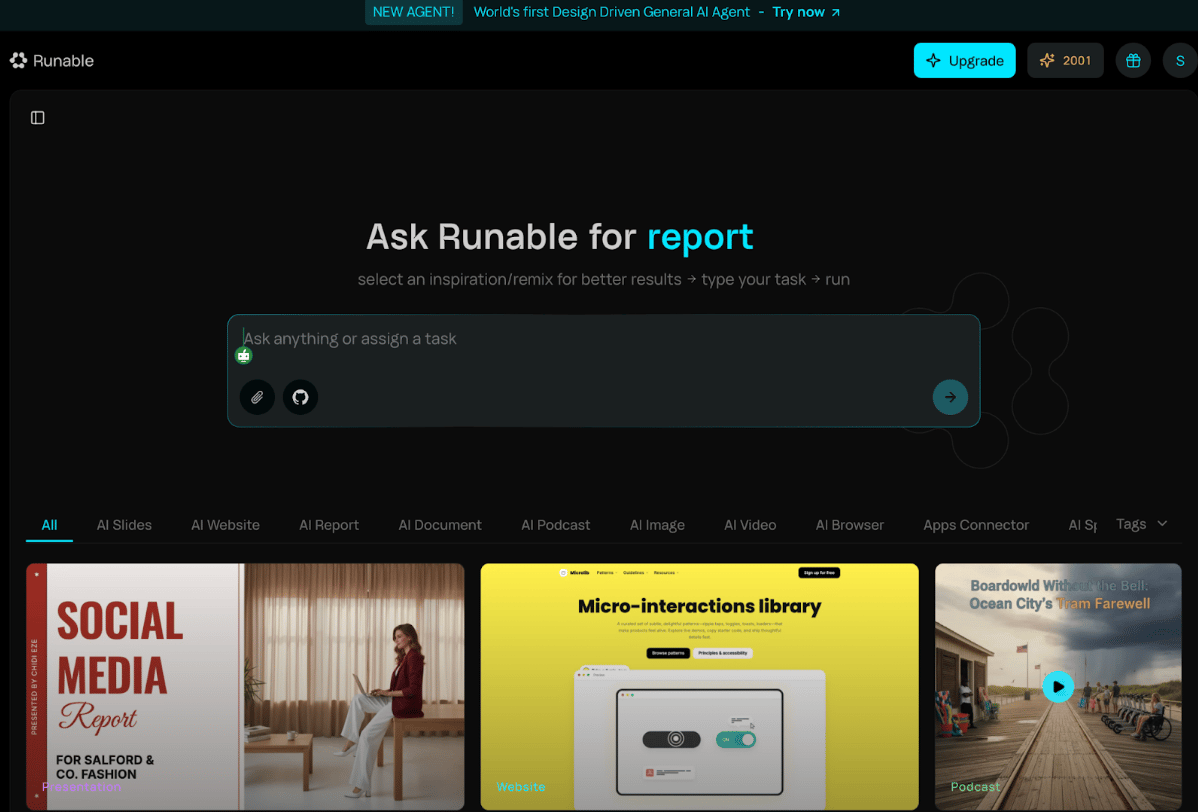
Runable connects 2,700+ apps (Gmail, Slack, Google Sheets, Notion, etc.) and automates repetitive digital tasks through simple conversation.
Step 1: Connect Your Apps
- Click "Connectors" in Runable
- Search for the app you need (Gmail, Slack, etc.)
- Click "Connect" and authenticate
- Repeat for each app you want to automate
Step 2: Describe Your Task
- "Update my Google Sheet when I receive emails from clients."
- "Send Slack notifications when someone fills my form."
- "Add calendar events from my Gmail confirmations."
Step 3: Runable breaks down your request into steps and shows you the workflow.
Step 4: Runable will ask for permissions or specific details (which sheet, which channel, etc.)
Step 5: Run it once manually to verify everything works
Step 6: Save your chat conversation, it becomes a reusable automation
Step 7: Tell Runable when to run: "every morning at 9 AM" or "whenever I get a new email."
Real Example: "Check my Gmail for invoice emails, extract amounts, update my Google Sheet, and notify me on Slack." Try here
Quick AI News Bites
Wikipedia has asked AI companies to use its paid API instead of scraping its site, hoping this will support their nonprofit mission and help manage server loads. Attribution of content is part of Wikipedia's guidelines for AI developers. Traffic from real people is dropping, so Wikipedia wants users to visit and contribute to keep its content growing.
OpenAI CEO Sam Altman is strongly urging the US government to expand the Chips Act tax credit to support AI server production and infrastructure for future growth. OpenAI wants tax incentives for AI hardware, not just factories, and plans to spend $1.4 trillion over eight years. The US government is discussing federal support, but a full bailout is ruled out.
Meta plans to invest $600 billion in the US to build new AI data centers and create more jobs across the country. This move supports Meta’s push towards “superintelligence,” where computers could outthink people. The company is rapidly expanding its infrastructure to meet future AI needs.
Boost revenue and gain new customers by partnering with us
Reach over 35K AI enthusiasts with your product.
Join our newsletter to connect with tech professionals, investors, engineers, managers, and business owners worldwide. DM now!
Got feedback, a story worth toasting, or a wild tech question? I’d love to hear from you; just reply, or find me on X.
Cheers,
— Poonam Soni